MIDI Drum Patterns: 3 Essential Grooves Every Producer Needs
Table of Contents
Pre-Flight Check: Fix Your Samples First
Pattern #1: The “Four-on-the-Floor” (House MIDI Drum Patterns)
Pattern #2: The Modern Head-Bop Trap Backbeat Groove
Pattern #3: The Lo-Fi Pocket Groove (The “Boom Bap” Feel)

Key Takeaways
Sound choice comes first: Even the best MIDI drum patterns won’t hit if your kick, snare, and hats are weak. Start with great samples.
Learn three “forever” grooves: A four-on-the-floor, a modern backbeat (2 & 4), and a lo-fi pocket groove will cover most songs you’ll ever write.
Groove lives in the details: Swing, velocity, and note length matter more than adding extra hits.
Humanize with intention: Keep kick/snare steady, then make hats and shakers breathe with small timing and velocity changes.
Build a personal library: Save each pattern as a 4-bar MIDI clip so you can start new tracks fast without staring at a blank piano roll.
I know, the blank piano roll is intimidating. You open your DAW, ready to make an absolute banger, click in a few hi-hats, add a kick, and suddenly your beat sounds less like a club anthem and more like a pair of sneakers tumbling inside a dryer.
Let’s take a deep breath. You absolutely do not need to be a world-class drummer to program amazing beats. You just need a few foolproof blueprints.
Today, we’re looking at three core MIDI drum patterns that will save you hours of frustration, the exact sounds to pick for them, and the secret sauce to humanize your beats so nobody knows you just clicked them in with a mouse. Whether you are using Ableton, FL Studio, or Logic, these MIDI patterns work across any DAW. Let’s dive in.
Pre-Flight Check: Fix Your Samples First
Before we start painting our masterpiece on the grid, we need to build the right foundation. A flawless MIDI drum groove will still sound terrible if your core sounds are weak.
The BPM Check: Match the pulse to the vibe. For bouncy House grooves, try 120–128 BPM. For modern Trap/Pop at 140–160 BPM, you’ll often feel it in half-time (70–80 BPM feel) for that spacious bounce.
Sample Selection: You can write the most sophisticated rhythm in history, but it needs the right voice to shine. Think of it like cooking: a Michelin-star chef doesn’t use stale ingredients.
The Kick: It needs to anchor the track. Choose one that commands attention, not one that asks for permission.
The Snare: Find a sound that cuts through the mix with elegance.
The Hats: Look for a shimmer that adds “air” and sophistication, rather than harsh noise.
Pattern #1: The “Four-on-the-Floor” (House MIDI Drum Patterns)
If you want to get people moving, this is your blueprint. It is the undisputed heartbeat of dance music and the most elegant way to establish a groove.
The Recipe:
Kick: Place one on every single beat (1, 2, 3, 4). Boom, boom, boom, boom.
Clap: Smack it right on the 2 and the 4, layered perfectly over the kick.
Hats: Place your open hi-hats exactly halfway between the kicks on the offbeats.
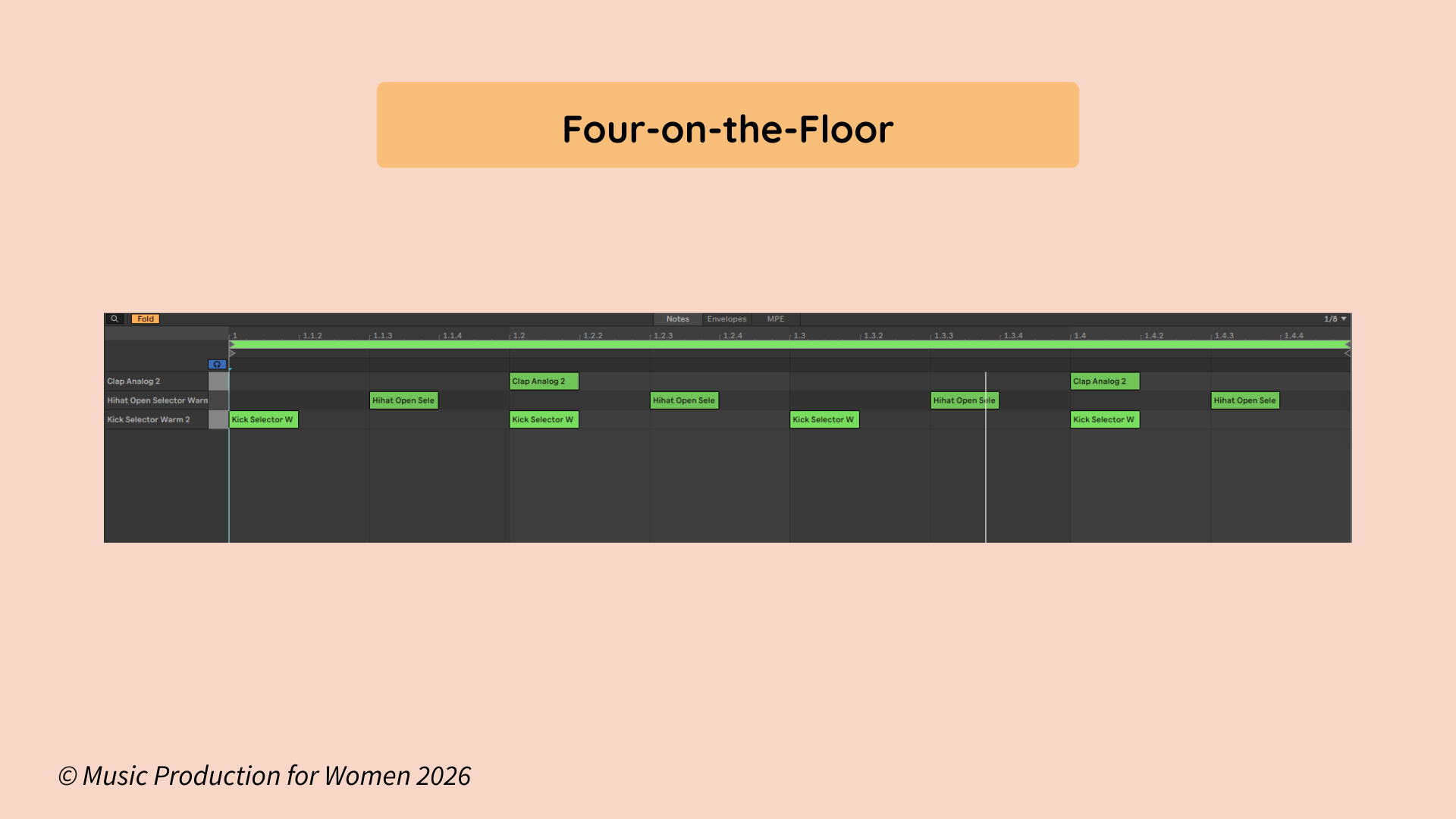
The Secret Sauce: Perfectly quantized house music feels a bit like a spreadsheet. To give this pattern that undeniable soul, highlight your offbeat hi-hats and nudge them ever so slightly late. This creates that irresistible push-and-pull pocket.
Pro Tip: Mute the kick drum for the very last bar of your loop. It creates an instant, effortless mini-buildup before the groove drops back in.
Pattern #2: The Modern Head-Bop Trap Backbeat Groove
This is the backbone of almost everything on the radio right now. It’s spacious, it’s bouncy, and it leaves a massive pocket for your vocals and 808s to shine.
The Recipe:
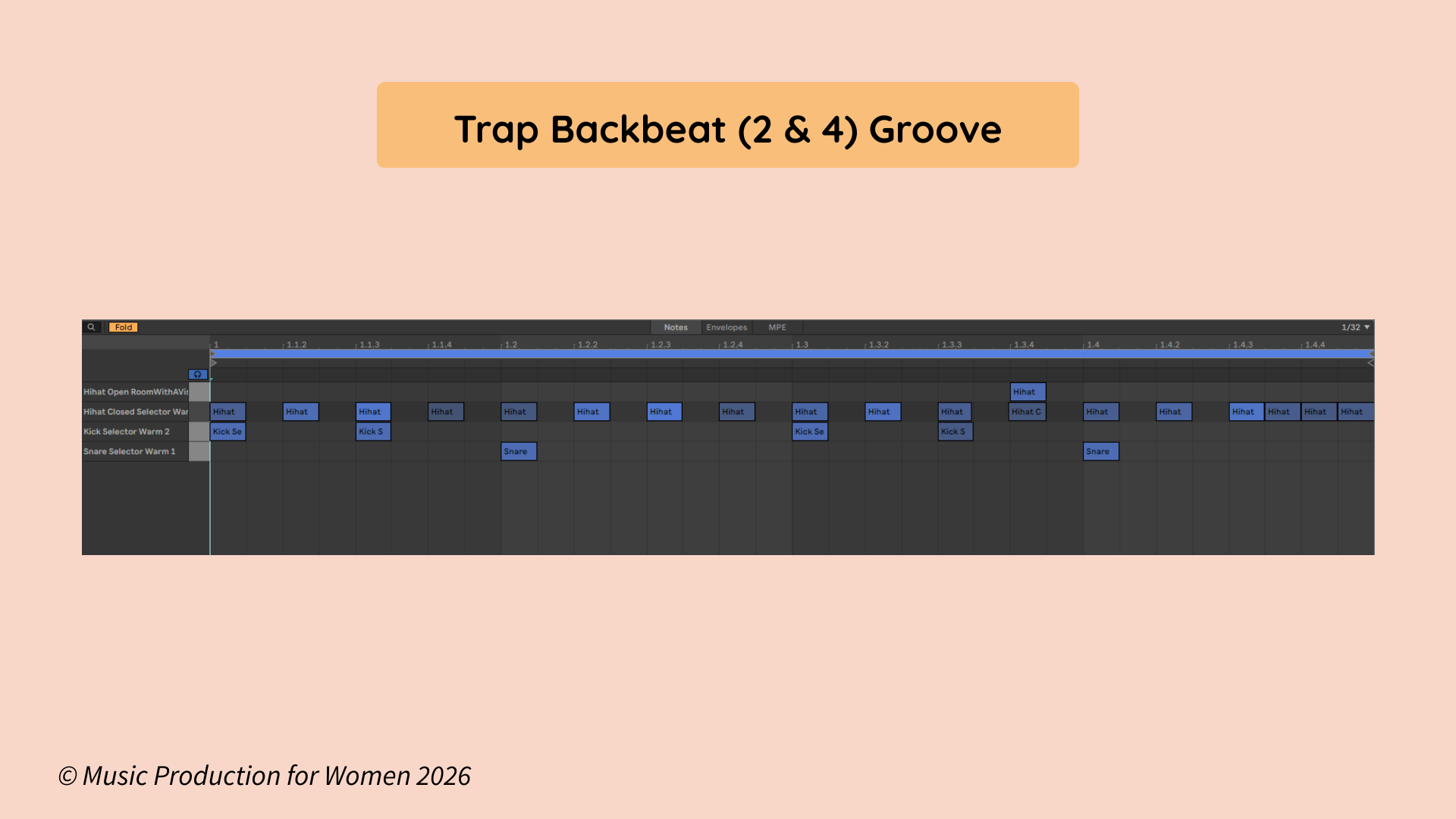
Snare/Clap: Locked on 2 and 4. Let it anchor the whole beat.
Kick: Start with one on the 1, then add a syncopated “ghost” kick between the snares for bounce.
Closed Hats: A steady stream of 1/8th or 1/16th notes. Add a tiny velocity lift near the end of the bar.
Open Hat: Place one right before the snare on 2 or 4 (start with just one). Keep the MIDI note short so it’s a clean “lift,” not a long wash.
The Secret Sauce: Sneak a tasteful little tambourine or a rimshot into the stereo field. Pan it left or right so your beat doesn’t sound two-dimensional.
Pro Tip: Add a classic 32nd-note hi-hat roll at the very end of your 4-bar loop. Just don’t overdo it, keep it classy.
Pattern #3: The Lo-Fi Pocket Groove (The “Boom Bap” Feel)
For those moments when you want to wrap the listener in a warm blanket of sound rather than punch them in the chest with sub-bass. This is the holy grail for soft verses, intros, or those “24/7 chill beats to study to.” The goal here isn’t to show off your math skills; it’s all about the pocket. Lo-fi drums need to sound like they’ve lived a little, dusty, muted, and beautifully imperfect.
The Recipe:
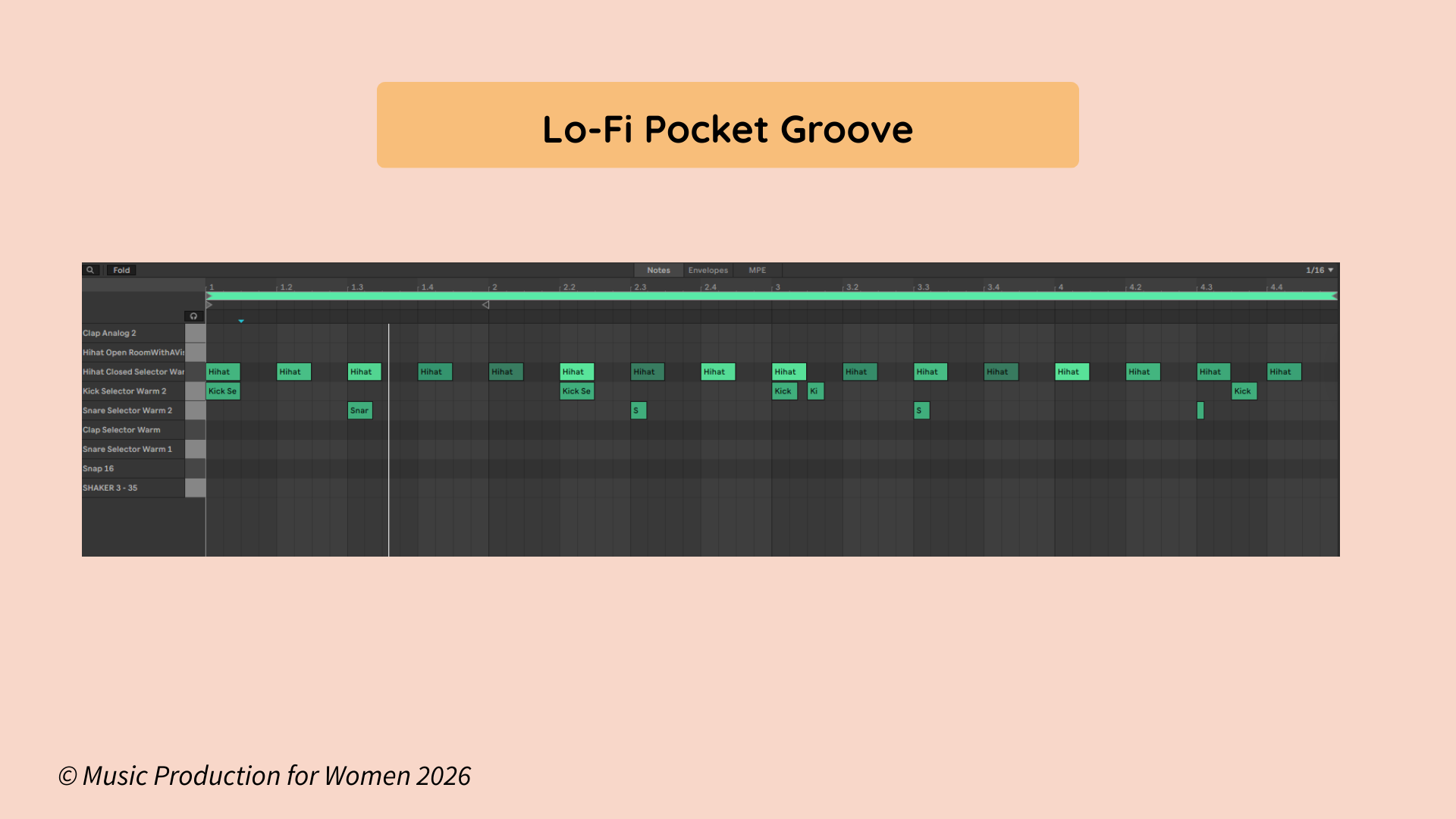
The Kick: Sparse and warm. Start on the 1. Think “gentle support.”
The Snare/Rim: Anchor the 2 and 4 with a woody rimshot.
The Hats: Steady 1/8th notes. The magic is in making them feel profoundly lazy.
The Ghost Notes: One tiny ghost snare or kick to create forward motion (keep it to a whisper).
The Secret Sauce (Feel, Not Math)
Keep your kick and rimshot mostly steady, but apply a heavy dose of swing to your hi-hats so they drag slightly behind the beat. Map velocities so the hats naturally rise and fall, and EQ out the harsh highs.
Pro Tip:
If it still feels “too perfect,” manually drag a few hats late and drop their velocity really low. Lo-fi groove is born from restraint.
The Human Touch (How to Humanize MIDI Drum Patterns)
Even with the best blueprints in the world, your drums will feel a bit rigid if they are mathematically perfect. If you want to create truly realistic MIDI drum patterns, here is how to add that producer magic:
Get Off the Grid: Aggressively quantizing everything to 100% perfection is the enemy of groove. Turn your quantize strength down to 70% or 80% to keep a little bit of that organic, human feel.
The Velocity Trick: Real drummers never hit a drum with the exact same force twice. Randomize the volume of your hi-hats just a tiny bit to make the beat breathe.
Note Length Matters: A super short, tight hi-hat creates rhythmic tension. A longer, slightly open hi-hat creates a wash of energy. Play with the length of your MIDI notes to change the entire vibe of the loop.
Want to Start Producing But Not Sure Where to Start?
Final Thoughts
The best way to get fast at drum programming is to build a library of favorites. Start with the House pattern today, get a 4-bar loop bouncing, and then save that MIDI clip into your DAW’s user library. Next time you start a track, you can just drag it in, focus on the fun part, and immediately start writing chords.
Forget about the perfect grid. The blank piano roll is no longer your enemy. You now have the core blueprints, you understand the velocity trick, and you know exactly how to avoid the “stressed-out robot” syndrome.
So, enough scrolling. Close this tab, fire up your DAW, and get to work. The world doesn’t need another perfectly quantized 8-bar loop; it needs your track. Now go make it bounce.
FAQ
Q: My drums are perfectly on the grid, but the groove feels stiff. Why?
A: Because groove isn’t math, it’s feel. Keep your kick and snare anchored, but nudge your hats a few milliseconds late and vary the velocities so the rhythm breathes.
Q: Should I use 1/8 or 1/16 hi-hats?
A: Start with 1/8 for a clean bounce. Move to 1/16 when you want more energy, but control them with velocity, or it just turns into noise.
Q: How do I stop hi-hat rolls from sounding like a machine gun?
A: Draw a velocity slope so the roll naturally builds or fades. Also, shorten the note lengths so the roll feels tight instead of washy.
Q: Where do ghost notes go without making the beat messy?
A: Place them just before or after the main snare, but keep them extremely quiet. If you hear them clearly, they’re too loud.
Q: How do I turn a 1-bar loop into a 4-bar progression?
A: Copy it 4 times, then add tiny changes: drop a kick in bar 4, swap one snare for a rimshot, or drop the hats right before a section change. Tiny moves create big momentum.