Build a Music Website (2026): Best Builders Free Options
Table of Contents
Choose a Website Builder for Musicians
Buy a Domain Name for Your Music Website
Free Options: Build a Music Website for $0
Create the Pages Every Musician’s Website Needs
Add Music to Your Website (Spotify, SoundCloud, Bandcamp)

Key Takeaways
The Best Builder: Use Wix/Squarespace for design, Bandzoogle for built-in music tools, or WordPress for total control.
Don’t Be Cheap: You can create a music website for free, but a custom domain looks way more professional.
Keep It Simple: Stick to 4 core pages: Home, About, Music, Contact.
Speed Matters: Don’t host big audio files on your site. Embed from Spotify/SoundCloud/Bandcamp instead to keep pages fast.
Own Your Audience: Social media is rented land; build an email list so you can reach your fans directly.
Let’s be real: Instagram is fun, TikTok is unpredictable, and Spotify is essential, but you don’t own any of them. You’re renting space, and one algorithm update can shrink your reach overnight.
The fix is simple: build a music website. One link that’s yours. A home base where you control the vibe, the data, and how people actually find your music. Promoters love it, fans love it, and you stop relying on whatever social decides to do this week.
And no, you don’t need to code. If you can use a DAW, you can use a website builder. Here’s the blueprint.
Choose a Website Builder for Musicians
If you’ve been searching for ‘website builder for musicians,’ you’re probably deep in comparison mode. Let’s pull you out of that. The best choice is the one that helps you launch quickly and get back to making music.
Here’s the simple breakdown:
Wix: Quick to set up, beginner-proof, and full of ready-made templates that work well for artists.
Squarespace: Polished, minimal, and design-led, most sites look great straight out of the box.
WordPress: Maximum freedom and scalability, but it comes with extra moving parts (hosting, plugins, updates, maintenance).
BandZoogle: Built specifically for musicians, featuring built-in tools for selling music and merch commission-free, alongside seamless fan-base management..
MPW verdict: Choose Wix or Squarespace for the fastest design start. Go with Bandzoogle if you want monetization tools ready out of the box. Choose WordPress only if you need complete control and are building a complex platform.

Should I buy a domain for my music website?
If you can, yes, it’s one of the simplest upgrades you can make. Your domain is your digital address (like yourname.com), and it helps your website look cleaner and more professional than a free link. Domains usually cost around $10–$20/year, and they also help you avoid clunky URLs like yourband.wixsite.com/site (which free plans often require).
If your dream domain is snagged (maybe by a dentist in Ohio), keep it simple: try yournameMusic.com, yourbandname.com, or yournameOfficial.com. If you’re not ready to invest, no worries, free plans are perfect for testing the waters. When the time comes, upgrading to a custom domain is a small step with a significant impact. Most premium plans on platforms like Wix, Squarespace, and BandZoogle actually include a custom domain for free for the first year, making the professional leap even easier.
Pro Tip: Try to use the same name across all platforms (your website, Instagram, TikTok, YouTube, Spotify artist name). It makes it easier to find and remember, and helps people trust they’ve got the right one.
Free Options: Build a Music Website for $0
Spent all your budget on a new synth or a vintage compressor? We get it. You can absolutely launch a site without spending a dime. It’s a smart way to test your branding before you commit to a monthly subscription.
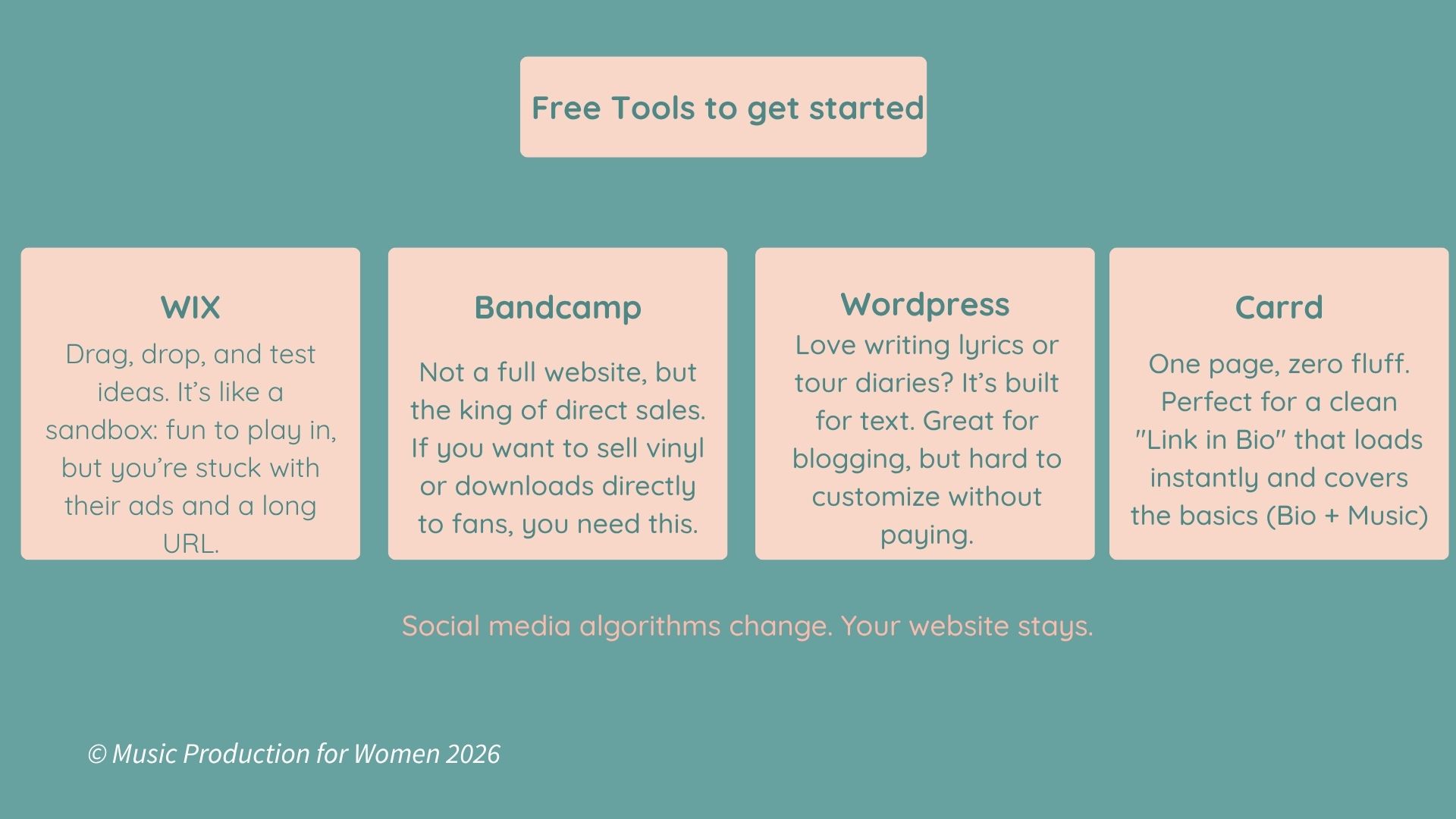
The Best Free Tools to Start:
Wix: Great for dragging and dropping to test layouts
Carrd: The digital business card. Perfect for a clean, one-page “link-in-bio” site that loads instantly and covers the basics.
WordPress.com: Perfect if you’re the type who loves writing tour diaries, gear reviews, or deep dives into your lyrics. It’s built for text, but on the free plan, you’ll hit a wall fast without custom plugins or themes.
Bandcamp: The shop. Not a full website, but the undisputed king of free storefronts for selling music and merch directly to fans.
The Reality Check: Let’s be real: free plans come with "digital roommates" you can’t kick out. You will likely have the platform’s ads on your site, and you won’t get the advanced SEO tools to help new fans find you on Google. It’s a bit like releasing a demo with a watermark over it—people can hear the song, but they know it’s not the final mix.
When to Upgrade? Simple rule: Upgrade when you want the industry to take you seriously. If you’re emailing labels, booking festivals, or running ads, a clean, ad-free site is the best $15 you’ll spend all month.
Quick Start Tip: Start free today to get familiar with the platforms, but pick one that can grow with you. It’s way better to upgrade an existing site later than to have to rebuild everything from scratch because you picked a toy instead of a tool.
Create the Pages Every Musician’s Website Needs
You don’t need a Wikipedia page. You need ‘All Killer, No Filler.’ Start with these four essentials:You don’t need a Wikipedia page. You need ‘All Killer, No Filler.’ Start with these four essentials:
Home: One strong photo + one call to action button (Listen, Watch, or Join).
About: A short bio (don’t write a novel) + a description of your sound.
Music: Your best tracks, clearly laid out, newest release at the top.
Contact: A simple booking form. Don’t just put your email out there unless you love spam.
Pro Tip: If you want to impress the press, add an EPK (Electronic Press Kit) page with hi-res photos and downloadable tracks.
Add Music to Your Website
The golden rule of music websites: Embed, don’t upload.
Uploading large WAV or MP3 files directly to your host can slow your site to a crawl. And nobody waits for a slow site to load. Instead, use the players where your music already lives:
Spotify Embed: Perfect for driving streams.
SoundCloud Embed: Great for demos, remixes, or WIPs.
Bandcamp Player: The best for direct fan support/sales.
YouTube Embed: Keeps people on the page longer.
Pro Tip: If you want to sell music or merchandise without paying commissions to third-party platforms, Bandzoogle offers built-in e-commerce tools designed to let you keep 100% of your sales. Put your freshest release right on the homepage so visitors can press play the second they land.
Build a Community and Stay Connected
Your website shouldn’t just be a pretty page people visit once and forget. Think of it as your fanbase headquarters: a calm, reliable place where listeners can stay close to your music without depending on social media algorithms.
Start with a newsletter. Email is still the most direct line to your audience because it lands straight in someone’s inbox. Keep it personal, not spammy, and give people a reason to join by offering something they can’t get on Spotify or Instagram, like an unreleased demo, a secret acoustic version, early access, or handwritten lyrics.
Then use your site for behind-the-scenes content that feels like a reward: short studio-diary updates, song stories, rehearsal clips, and raw moments that don’t always belong on your primary feeds. Make it two-way, too. Add a simple Q&A form, ask for cover art opinions, or let fans vote on a setlist choice; small involvement creates real connection.

Finally, make your website the hub. Embedding your Instagram, TikTok, or YouTube feed keeps the site feeling alive and helps fans follow you in one place, even if they’re not on social.
Keep it simple: one signup form, one behind-the-scenes post, and one clear invite to stay connected.
Want to Start Producing But Not Sure Where to Start?

Don't Build on Rented Land
Ultimately, social media platforms are like rented apartments; the rules (algorithms) can change, or the rent can go up at any time. Your website and your email list are the only digital assets you truly own. By prioritizing direct connection over passive scrolling, you aren’t just getting clicks; you are ensuring that no matter what happens to Instagram or TikTok, you will always have a way to reach the people who matter most: your fans.